HOW TO FEEL OK ABOUT NOT BEING OK

during senior moments

Photo by Anna Tarazevich on Pexels.com

when I wake up and before I sleep, when the feeling of not being ok is most sharp.

From books to TV dramas, this topic of acknowledging your feeling of not feeling ok is becoming a cliché. The premise for this adage is that most of us are not honest about our feelings. As we move within our professional circles or communities, we tend to camouflage our feelings especially when we are supposed to lead the way, in mentoring persons or groups. Before friends, we tend to pretend in order to blend. We hide our true selves before our loved ones to avoid adding to their burdens. Acknowledging the feeling of not being ok is easier said than done. For if we can’t acknowledge it before others, then we have not acknowledged it at all.

talk to someone

Most TV dramas I’ve watched involve close friendships and buddy relationships. The teleplay will always craft a loyal, unassuming friend who listens and responds compassionately. This buddy and companion always gives their friends priority attention in times of need. It takes a long time to develop this kind of relationship. When a fall out happens, the misunderstanding leads to ghosting or erasure. All light and heavy conversations about anything with friends will cease. Lost is the privilege of talking to someone without fear of judgment. Gone is that lightness of being resulting from sharing. Then it will take a long time to find a new confidante.   

engage in self care

My niece told her mother about her boredom with house chores. She had to give up her work in advertising when she had a miscarriage. After that, even working from home presented too much risk. So she stopped working altogether. Eventually, she got depressed. My sister advised her to go window shopping. When she was a young single mother, she used to take her children to the mall, whenever she felt tired and lonely. Her daughter remembered those times in the mall. In those times of useless malling her Mom fitted shoes and clothes without buying, pleasing herself with a momentary new look now and then. My niece obeyed her mother’s advice and went window shopping. She came back home with an upbeat energy, having momentarily escaped that feeling of not being ok.

meditation in poetry

The poet Christian Wiman wrote, “Poetry arises out of absence, a deep internal sense of wrongness out of a mind that feels itself to be in some way cracked.” My ‘meditation’ happens on paper because writing is therapeutic. Poetry in particular is a way of thinking meditatively. In writing poetry, I pause at every line. I struggle with every word and phrase. The meaning of the poem becomes clear to me only when the poem has finally become a poem. Writing a poem is multiple rewriting of structured notes, similar to the endless revision of our lives as we discover some new ways of being. The very first poem I wrote is entitled

journal entry
©1987

Once I tried to weave a verse

for pages back I weaved

but couldn’t stitch more lines than one

and so I went to sleep

and dreamt of verses that are echoes

of life’s embittered cries

and words escaping from the ghettoes

of unfulfilled desires

verses sounding and resounding

rhythmic flowing replies

to question marks abounding

in sleep their wise disguise.

exercise

How not ok I feel could be expressed through aimless walking. Walking without a destination turns negative energy into exhaustion. This exercise cause my pale skin to turn red. I lose the zombie look and gets a halo.

creative expression

One thing that I had always done, collecting art materials and storing them in my old leather bag. I have always wanted to paint. However, I have not painted at all. Not ok with not having done a sketch of even one decent picture, I do an inventory of my paint colors and brushes now and then, to keep hoping. My last sketch was of my Mother when she was still with me. I can’t find this sketch immediately but its the widget at the bottom of Page a Writer that links to this Y.A. blog.

set small goals

I’ve always gotten ahead of myself, or counted chicks before the eggs have hatched. My mouth outpace my vision and I end up projecting but not delivering. But dreaming is a way of coping. When I am not ok, I review the dreams in my journals, highlighting what has been achieved however teeny-weeny.

keep the space clean

I am not ok with noise and a messy home.  I can feel clutter even if I don’t see it because my house is small. Every bag and basket in my home is for storage of basic and mundane things. When I am not ok, I destress by organizing those ‘bagged’ objects, ensuring that every thing I’m keeping away deserves the space. This relaxes me.

listen to music

I find walking with earphones, and listening to music while doing something else, tedious and stressful. Restaurants play background music too loudly-not at all music to my ears. Neighborhood karaoke singing assaults my ear drums. How do I cope in the midst of noise and mess? I leave that space for one that is quiet and orderly, where music adds to the ambiance. But almost always, this space is expensive.

maintain a routine

There is the routine bad habits and the routine that is productive. Routine bad habits include drinking expensive coffee every morning,  eating halo-halo or puto bumbong for dessert, risking a sugar spike, and binge watching on Netflix until very late in the evening. The routine that is productive involves the exact opposite of those three. But when not ok, meryenda and watching K-drama on Netflix is my default-not- ok normal.

seek professional help

My doctors are the following: An endocrinologist, a cardiologist, an EENT specialist, an ob-gynecologist, a breast cancer surgeon, a throat specialist, and an ophthalmologist. Aware of my mortality, I am ok only as far as ok can get. Indeed, my health card is proof of this.

Leave a comment

I FIRST WROTE THIS POEM IN ENGLISH

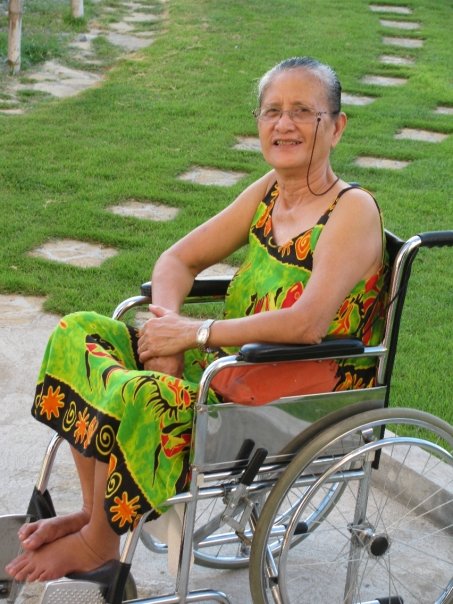
Inay on a wheelchair

When my mother got ill with cervical cancer, I resigned from my job to be with her. Her body deteriorated slowly until finally, even putting her in a wheelchair could break her fragile bones. Staying long with her at home was not difficult, but I missed the stimulation of the city. Cooped up in our small apartment, I resorted to online translation and flourished.

Our small apartment was the last in five doors and the smallest in square meters. We could hear our neighbors all the time, even when their doors were closed. We had only a ‘right of way’ to our little gate being the last door in five, so I was a body visible to every neighbor as I walked in and out of our house. Ironically, this made me more protective of myself, that I hardly talked or mingled with a neighbor, unless it was Christmas or New Year, when everybody would be out to greet each other and make noise.

WRITING POETRY WITH INAY

Although weak and weary, my mother, Inay, maintained pots of bougainvilleas and San Francisco plants, and some fortune plants as well. She loved her plants, but when she couldn’t any more water them herself, it became another one of my chores.

Working as a translator at night and trying very hard to sleep by day, I always forgot to water those plants and was delinquent as well in cutting and trimming them.  But Inay wasn’t complaining. A time came when her periphery of vision was not going beyond the front door. Upon waking up, she would just get up and sit on the bed until she felt the need to relieve herself. She occupied a wooden papag downstairs, while my ‘office’ was upstairs. In the morning before breakfast, I would walk to the market to buy some tamales, or kalamay, or puto and the two of us would have that for breakfast with coffee. During those breakfast hours, she would tell me stories about her younger self, and I savored those moments. The two of us would be eating lunch together while watching Eat Bulaga, and supper together viewing some Teleserye.

When my mother was still able to move in her wheelchair, she prepared and cooked all our food. But when it was not possible anymore to get out of bed, she did not resist when I opted to take out fast food from the nearest restaurant. Sometimes, I tried to cook, however, I could not enjoy the food I cooked. I had always been underweight but with Inay always cooking the food I bought in the wet market, I happily gained weight.

Hopelessly, I went back to being thin again when she stopped cooking.

As my mother weakened, I felt helpless. All the poems I was writing at the time were about her. Whenever I felt too tired and lonely, I often left for a while, took the bus from Batangas City to Makiling in Laguna, and just stared at that lovely mountain for about two hours. Then I would ride the bus again back home. Once home, the only place to be when I was feeling exhausted was the terrace.

VIEW FROM THE TERRACE

copyright (c) Jophen Baui April 4, 2007

I tire myself over a book

Stocking insights for future verses

Otherwise, it is limited to the color and smell

Of spaced-out neighborhood

Devoid of will and yet full

Of natural excesses:

In the vicinity of pots

Creeping vines unnamed and unbecoming

Are as wanton as their dreams.

Indecisive bougainvillea devoid of a trellis

Hanging on to wash lines,

No wind touches a petal of their pink profusion.

Each stem of the neighbor fortune plant

Struggles to be free from juvenile entanglements

Of surreptitious vines clinging to posts

Blackened with secure grime.

Every will of greatness has been tampered.

Pools of mud from overflowing canals

Humid April dulled visions

Immune even to the noise

Of children’s nonsense

That can break through

This weary plainness.

RE-IMAGINING INAY’S POTTED PLANTS

Revising this poem made me re-imagine my mother’s potted plants. After she died, I left our house and went back to Manila. Back on the streets and commuting, I was now seeing the same kind of plants on the road. Some bougainvilleas were planted in some island parts along EDSA. Some plants crept under the overpasses, others fell on their vines from the highest brick of a walled subdivision. At first, I enjoyed the long ride to school when I lived in Cavite after thirteen years of staying in my mother’s house. I always brought a book to read on the bus when traffic stood still. I realized that my time slowed down so I had to speed up. But I somehow enjoyed the unhurried pace and often tried to retrieve images from my mother’s full life.

MULA SA TERIS

From HUGOS © Jophen Baui 2024

Basa nang basa ng libro

ipon nang ipon ng maisusulat

Kundi ay kulay lamang at amoy

ng naubos nang kapaligiran

Wala ng igtad wala ng malay

di na lumalabis ang kuwento sa karaniwan

Ayon sa mga masitera, gumagapang na halaman

anong pangalan, di maunawaan ang pakay,

Tulad ng bugombilyang naghahanap ng sampayan,

sumama na lamang sa mga damit

Nalumbay ang hangin na di man lang makahalik

sa rosas na binakuran ng mga sanga ng suwerte

Halamang sinungaling sa namamanhik ng pag-asa

na makatatakas sa panggagahasa ng usok

Natuyo nang lahat ang mga dahon na kapag nahulog

tutuloy sa baradong kanal

Sumisinip-sinip ang kanilang pananaginip

sa burak ng mga pinaagos na pawis

Rating: 1 out of 5.

Designed with WordPress

WHAT YOU NEED TO START WRITING – WORDHOUSE WISHTICKLES

Photo by Judit Peter on Pexels.com

If you are like most writers, your first hurdle is how to start writing. You may have cultivated the habit of journaling or writing in your diary, yet when it is time to write that book you have been dreaming about, you end up staring at the screen, or in a dramatic showcase of frustrated writing, your trash-can overflows with crumpled paper. But when does writing commence? Writing begins when you sit down and write.

IN BRAINSTORMING YOUR SUBJECT

As soon as you begin encoding letters, words, and phrases, you are already writing. Rarely will the codes you type be considered final sentences and expressions of your ideas. But whatever they are that you have initially penned, those are your starts. Those ‘brainstorms,’ are sparks of creative insights that may or may not find their place at all in the final document.

A common misconception about brainstorming is that it is a random formulation of subjects from a clash of many heads. But writing is the job of one single person at one set continuous time. The brainstorming is done by only one creative head who will inevitably talk to itself alone throughout the writing process. This means that the author-originator must be deliberate with a free and unencumbered brainstorming. If in the process they end up with more than three pages of nonsensical and unorganized thought, so be it. Stop crumpling the paper, but save the document with a date, and dating subsequent revisions as well, keep the initial drafts on file.

Brainstorming yield your first thoughts in writing. You may not yet be aware of your subject but are biased towards an opinion or viewpoint. You may not have yet established how you’re going to package your ideas, but are leaning toward a form. You may not be fully informed but eager to research and dig deeper into a topic. Whatever your leaning may be, brainstorming will light them up for you so you will find the way toward a vision for a project.    

IN GATHERING YOUR REFERENCES

Research is a fearsome word. The stereotypical impression is that of a scholar buried under a pile of paper, glasses falling off her face as she reads through pages with furrowed eyebrows. However, as a writer you need to seek out the relevant literature at the very start. You need related texts to capture the free fall of creative imagination. Research will give you a framework. It is a wisdom catcher that will bring your ideas together. Resulting citations will have made you check, suspect, or validate assumptions and presuppositions. You gain authority in the subject matter at hand.

IN JOURNALING YOUR EXPERIENCES

What about the process itself? Writing is a reflexive exercise. Once you sit down and write, you are very much aware of your process. How efficient is your method of writing? How disciplined? How relaxed? How egoistic? How sensitive? Often writing starts here as well, when you become self-aware. Do you take down notes on the go? Do you keep a notebook and change it only after you’ve filled it out entirely? Do you write down dialogues you hear as you commute? Do you keep a notepad of quotations?

Consult your journals, your letters, your diary, and even those back of receipts where you wrote down bullet points of wisdom. What is it that you always wrote about and why? How were you able to write in an unhurried pace or under a tense situation? Can you recall how you came up with one cohesive statement? Are you writing about personal desires using gut expressions? When you start writing, every process is a precious first note of how your text may eventually sing.

IN WRITING A FIRST DRAFT

You have reached a point when all that brainstormed ideas have narrowed into one united thought. Now is when you try to harmonize your concept by thinking about an audience. You need to ask at this stage, who will read what you have written and why? How will that reader not misunderstand? How will this writing resonate with that audience hearer?

Writing the first draft involves a hearer. There is always that ear of attention an author-originator will have to seduce through set, contemplative ways. That ear will hear because what the final draft is saying has aimed for it to listen. Deliberately, writing the final draft is a performance of careful attention to detail. The grammar, syntax and diction forming the major units of thoughts need exactness and fluency. Usually, the draft will, at this final form, exhibit the writing voice, or the style, or the angle, or beat. The final draft has made only one cohesive claim or perspective. Ambiguity is completely gone, and at least for that one target hearer and audience, a point has been made.

WHAT MAKES ME THINK THE DAILY COFFEE HABIT IS NOT EXPENSIVE

Photo by Clem Onojeghuo on Pexels.com

I have been consuming brewed black coffee every morning, to go with corned beef pandesal. My dine-in beverage is always served with warm and cold water on the side, plus two brown sugar and half a cup of milk. Breakfast takes up at least two hours while I watch a K-drama episode with an ear-phone plugged into my ears. Between 7 and 9 AM sipping the hot brew relaxes and empties my mind of serious stuff.

While I prefer the coffee black to go with my bread and meat, I always pour the hot milk and stir in the brown sugar on the remaining coffee when I’m done eating. The coffee that I take with me to work will be my drink for the whole day. Little by little, it will be consumed while I labor on my lesson plan, check student papers, and deliver the class lecture.

I used to feel guilty about the cost of this habit. But not anymore. Breakfast time is a healthy downtime for me. I walk three blocks more from the coffee shop with a backpack that has my laptop. On the road, there is not much to see, but there is room for meditation. My mind doesn’t wander away much from the day’s routine, however, I become more alive and ready for what may or may not happen. My pace is uncalculated, there’s no reason to hurry. I have been savoring this slow pace enhanced with good coffee in a mug that fits in another bag I carry, a sling bag. Walking gets organically woven into this slow movement and I say that it is my morning exercise. Coffee will never leak from the mug in this fifteen-minute walk, but I’m mindful of its presence, as it has become a paraphernalia of my senior year.

MEMORIES OF PURE AND ADULTERATED COFFEE

As a ten-year-old child, I used to run to a nearby sari-sari store in the morning to buy coffee. The vendor will grind a ganta of Barako and wrap the ground beans in a cone-like roll of writing paper. My mother will boil water in the kettle and when the bubbles appear, she will pour the coffee. She will turn the fire to its lowest before pouring the aromatic breakfast drink into our tin bowls. We dipped our bread in the coffee, or if we were having rice, we poured the coffee onto the rice, and we ate our coffee-brimmed rice with pinais or pinangat na isda.

In my grandmother’s house, she served ‘utaw‘ or boiled ground black rice. We considered utaw our First coffee since it would always be the one served with hot bread as soon as we woke up. Then at around 10 AM during my grandfather’s break from weaving palm leaves into panels that would be lined up for roofing a nipa house, Nanay would serve the real coffee in tin mugs. We knew it was time to eat again, with coffee aroma wafting in the atmosphere. Her grandchildren would all sit on the wooden bench around the long wooden table. As our palates demanded, we poured the second coffee liberally on our fried rice, scooping mouthfuls and strips of tinapa with our bare hands.

Coffee and rice had been the comfort fast food up until I was a teenager. We did not filter our coffee and recycled the drink many times until it turned into a pale black and lost its aroma. We took it with bibingka, sweet potato, cassava cakes, boiled bananas, and pancit. When I left the province to work in Manila, coffee became rare and special. There was no way I could get it fresh and cheap from a nearby store. Instead, it was available in ‘three-in-one’ sachets of beans that were often boasting their quality. To me, a three-in-one tasted something akin to baking soda mixed with sugar. But I drank it anyway, as I hurried up before walking or riding the bus to work. Coffee wasn’t a beverage but a comrade, a prompt for the empty stomach during the early rush hours. The morning routine required a partial or full sip of this hot blend, to ensure that I was fully awake and ready to brave the day.

UNCONSUMED COFFEE TO GO FEEDS THE WRITING HUNGER

Consuming coffee little by little while writing is like having an hourglass that tells me when my blogging time is up. I started with a full mug of leftover coffee and after three hours, it was finished. Drinking coffee has made writer’s block less daunting and more tolerable. A  reason to plod on was that the mug was still half full. When I’ve consumed all the coffee I bought, I can pause from thinking. Though I have penned thoughts rather than ideas, I am not hungry for more. Tomorrow, when the day begins, I can buy brewed coffee again, and go back to writing.

HOW NOT TO PANIC WHEN YOUR VITAL SIGNS SHOW YOU ARE NOT HEALTHY

16 Therefore we do not lose heart. Though outwardly we are wasting away, yet inwardly we are being renewed day by day. 2 Cor 4:16

Rosuvastatin, 10 mg, Metronidazole forte and Cefuroxime are the latest pills prescribed for my health issues aside from the maintenance drug Levothyroxine for my thyroid, and Caltrate plus and vitamin D to prevent osteoporosis. The statin which the cardiologist always prescribed since 2019 but I had refused to ever take, has finally earned a slot in my pill box.  This requires an adjustment of the budget for medicine, which currently covers only the multi-vitamins and the thyroid pill.

The side effects of a statin drug according to ‘concerned’ YOUTUBERs are muscle pain and weakness. Proponents of the Keto Diet argue that taking this lowering cholesterol drug will actually cause an imbalance in the body’s cholesterol levels, and will make it worse.  Yet my doctor insists that I take it because my blood pressure stays up at 140 over 90 and goes even higher.

Should you panic about your current health condition, considering how it has been in the past?

Walking from ST. Luke’s Hospital to the Uptown Mall takes twenty minutes. I paced normally, with no issues, no dizziness, no nausea, no muscle pain, no nothing. This time of blogging [9:06-10:25 PM] attests to my feeling healthy, because while crafting this article was slow and tedious, I had enough energy to stay awake and write to the end.

As a teenager, I often fainted because my meals were not full enough to carry me through the school day. In my thirties, I was hospitalized twice due to episodes of benign positional vertigo. Thyroidectomy, Polypectomy, Mastectomy–I had these in my late forties. Now in my pre-retirement years, fainting has never re-occurred, my vertigo has not acted up. But new spasms in my stomach pressure me to avail of the health card’s executive check-up benefit.

Three days of pain on the right side of my belly was a cause for panic, but I took no drug until after I saw the gastroenterologist. By the time of my appointment, the spasms had faded and my bowels had returned to normal. I regretted buying all the prescribed medicines for the spasm. Hopefully there won’t be a relapse of the gall bladder issue, but just the same, I had bought the drugs and they were expensive.

Why do you panic?

Panic is not programmable as if clicking on some buttons will heighten or prevent it. But it happens when the budget allocated for medicine suddenly increases. The stress is caused more by limited finances rather than bad health, especially if the pathology results demand rare expensive drugs. My mother used to say that were it not for the medicines prescribed for her cervical cancer and its complications, my brother’s remittances could have purchased for her some new assets or afforded an inter-Island tour. But yes, she did not at all panic because she had a health card, an allotment for medicines, and a daily allowance for food and other basic needs.

How not to panic when your vital signs show you are not that healthy?

The safest recourse is to make sure that there is an allocation for all the cost of ill health, even if you are asymptomatic. Manage the proceeds of your government health insurance. The time has come as well to apply a portion of your stock dividends to medical contingencies. Don’t hesitate to initiate a dialogue about your financial emergencies with your nearest kin to give them an opportunity to give back. Be honest about your needs to those who can support you.

But other than these, the best safeguard against panic is still a renewed commitment to a healthy lifestyle. Eat better food, walk more blocks, pray all the time, sleep early and read more. These don’t even cost that high.

For the elderly, panic is a useless reaction because every moment must count and panic is a waste of time and energy. Worrying about our health will further shorten our days which have become shorter. And although we can still dream, we can count fewer opportunities of chasing those dreams. Since our future is here, let us then perfect the art of numbering our days. Instead of panic, we must spend our less than robust days in quiet meditation, to prepare our mind and body for the inevitable.